Business Continuity is the combination of planning, mitigation, and recovery efforts an organization performs to restore critical functions and services following a significant business interruption. These interruptions may be:
- Naturally occurring incidents
- Human-made incidents
- Technology-based incidents
Regardless of the interruption’s origin, a business continuity program helps to support the resiliency of the organization; ensuring internal departments can withstand long-term impacts. It is important to note that the term “business” does not solely refer to traditional business functions (administration, budget, finance, etc.). Rather, the term “business” refers directly to whatever the business of your organization is, be it research, academics, facilities operations, or any other function on campus.
Business Continuity vs. Emergency Management
While fundamentally related, business continuity and emergency management are separate, distinct programs.
Emergency Management | Business Continuity |
Prioritizes preparedness, mitigation, response, and recovery from immediate, life-threating emergencies. | Prioritizes planning and mitigation efforts related to long-term recovery of critical organizational functions once life safety threats have been resolved. |
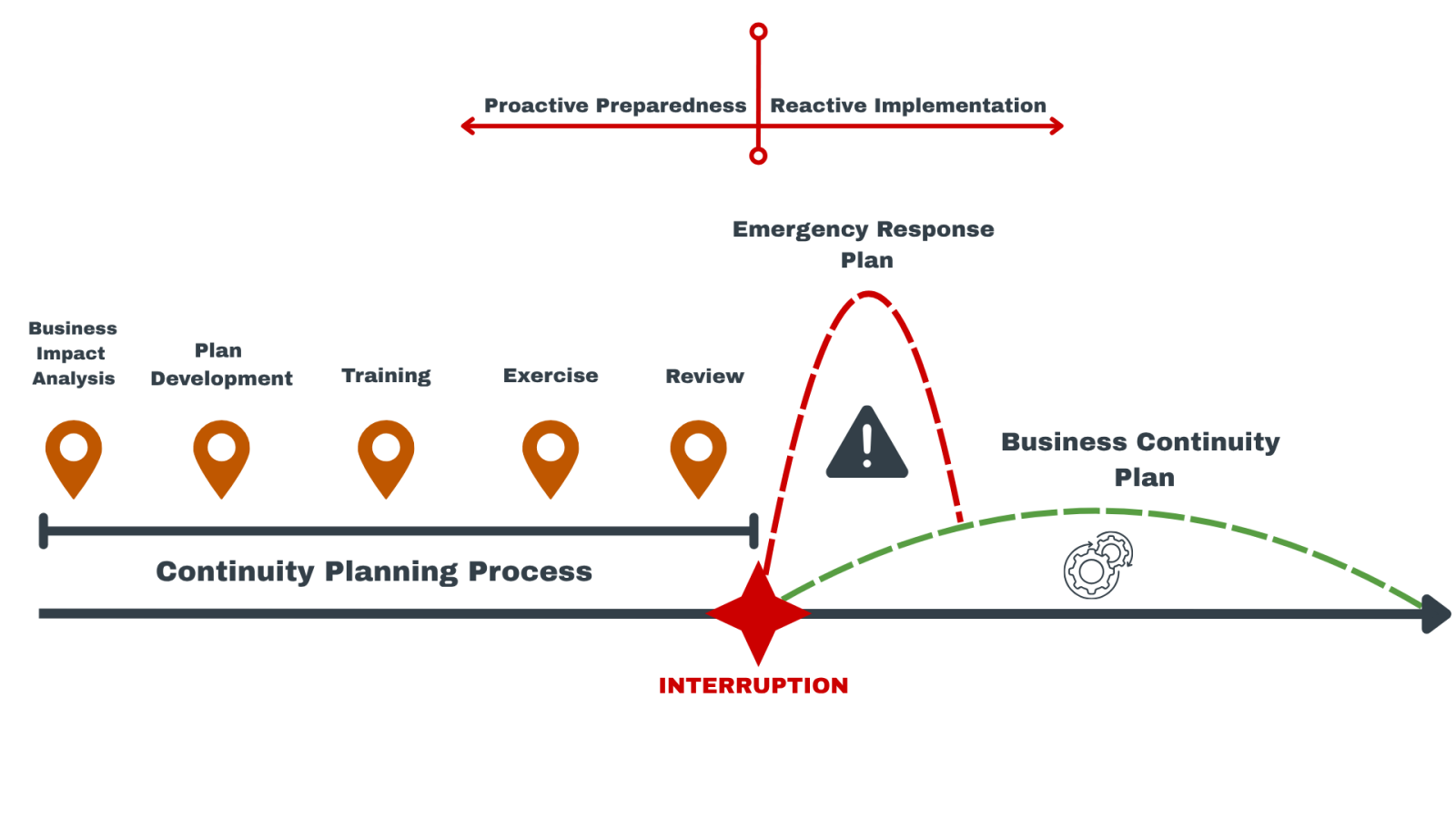
Below is a graphic demonstrating the difference in duration of a business continuity plan, as compared to an emergency response plan. While the incident or interruption that triggers the activation of these plans may be the same, as is their planning cycle, they each have unique priorities relating to the actions needed to be taken by students, faculty, and staff.
How does Business Continuity apply to UT?
There are a significant number of functions that occur at UT Austin that can tolerate little-to-no-downtime. From the micro-grid that powers the Forty Acres, to the life-changing research going on in the thousands of labs across campus, it is essential that our university continues its important work regardless of interruptions.
The business continuity program under the Office of Emergency Management serves as the disaster recovery function of the university, supporting planning, mitigation, and recovery efforts across all colleges, schools, and units. The purpose of this program is to implement a comprehensive and standardized approach to business continuity throughout UT Austin, which is continuously evaluated and improved over time. If you would like assistance developing a business continuity plan for your department, reach out to emergencymanagement@austin.utexas.edu for more information.
Business Continuity and Disaster Recovery (BCDR) Council
In partnership with Enterprise Technology, the Office of Emergency Management BCDR Council was established to provide strategic direction and general guidelines for all campus wide continuity efforts. The BCDR council consists of constituents throughout the institution whose role involves, influences, directs, or supports continuity related initiatives.
The purpose of the BCDR Council is to guide and steer institutional efforts to prepare for interruptions of daily business operations and – when it is possible to do – lessen or mitigate the impacts from such events. Councilmembers will make recommendations regarding the University’s policies, procedures, and practices regarding continuity efforts. Members of the Council represent a variety of the University’s academic, research, and operational areas and/or interests.